

Bangkok, 31 August 2026 – Professor Sangam Shrestha of the Faculty of Civil and Environmental Engineering (FCEE) and Co-Director of the Global Water & Sanitation Center (GWSC) at the Asian Institute of Technology (AIT) represented AIT at a briefing on “The Bhote Koshi Flash Flood: Causes, Consequences and the Way Forward,” organized by the Embassy of Nepal in Bangkok in collaboration with the Asian Disaster Preparedness Center (ADPC).

The session brought together representatives from Thailand’s Ministry of Foreign Affairs; the Embassies of China, Pakistan, Sri Lanka, and Switzerland; the United Nations Environment Programme (UNEP); Save the Children; AIT; and other international organizations and technical partners. The discussion highlighted the transboundary and multi-hazard nature of the event, limitations in existing warning arrangements, and the need to connect immediate response with resilient recovery and longer-term adaptation and risk reduction.
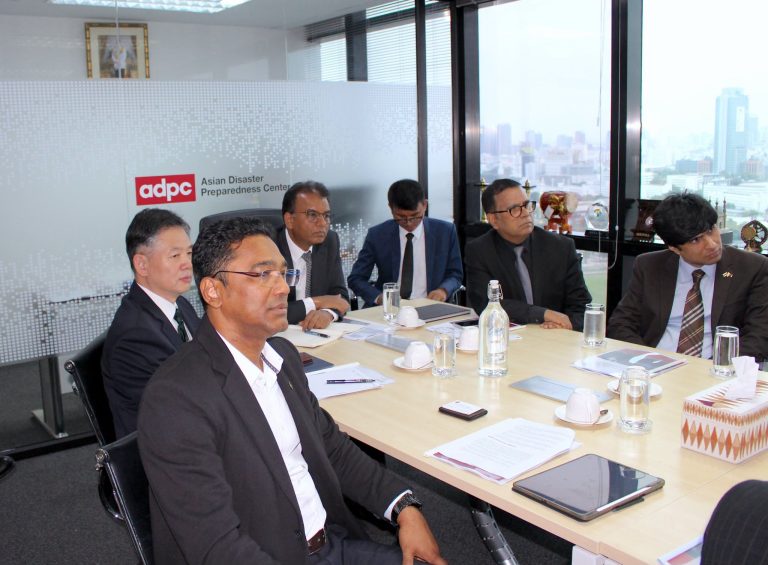
Prof. Sangam Shrestha at the briefing (Credit: ADPC)
Professor Shrestha’s Contribution to the Panel
Drawing from his expertise and experience, Prof. Shrestha pointed out a number of priorities for strengthening preparedness against hazards across the region:
- Improving the understanding and communication of cascading multi-hazard events
- Establishing a regional multi-hazard risk assessment programme for the Hindu Kush Himalayan (HKH) region
- Developing integrated regional and local multi-hazard early warning systems.
The panel of expertise agreed and emphasized the importance of partnership, collective action and sustained investment in preparedness to ensure that recovery addresses the needs of affected communities and reduces future risk.
The Bhote Koshi Flash Flood
In Nepal, on 26 August 2026, a massive flash flood in the Bhote Koshi River, originating in the high-altitude border areas of Rasuwa District caused severe loss of life, widespread displacement, and extensive damage to property and infrastructure. The flash flood, reportedly triggered by a glacial collapse on 26 August, swept water, mud and rocks through communities in the affected districts. Nepal has reported over 1,000 dead, with over 4,000 people reported missing.
The Government’s approved estimated affected population: 84,270 people over 17 municipalities in 6 districts – Rasuwa, Nuwakot, Dhading, Chitawan, Gorkha and Tanahu. An estimated 556,200 tonnes of building-related debris are associated with currently assessed buildings, with a broader indicative estimate of 2.2 million tonnes including personal property, vegetation, rock and sediment mobilized by the floods. Preliminary modelling estimates USD 158.6 million in potential building damage, with a ±30% uncertainty range. This does not represent total disaster losses.