Nakhon Pathom – On 8 July 2026, WEM research associates, Mr. Bikram Pandey and Ms. Udomporn Tupbucha, from the research group of Dr. Natthachet Tangdamrongsub participated in the Network Week for Integrated Knowledge Sharing (NWIKS) under the auspice of the 19th THAICID National Academic Conference (การประชุมวิชาการ THAICID ครั้งที่ 19), held at the 80th Anniversary Building, Kasetsart University, Kamphaeng Saen Campus.
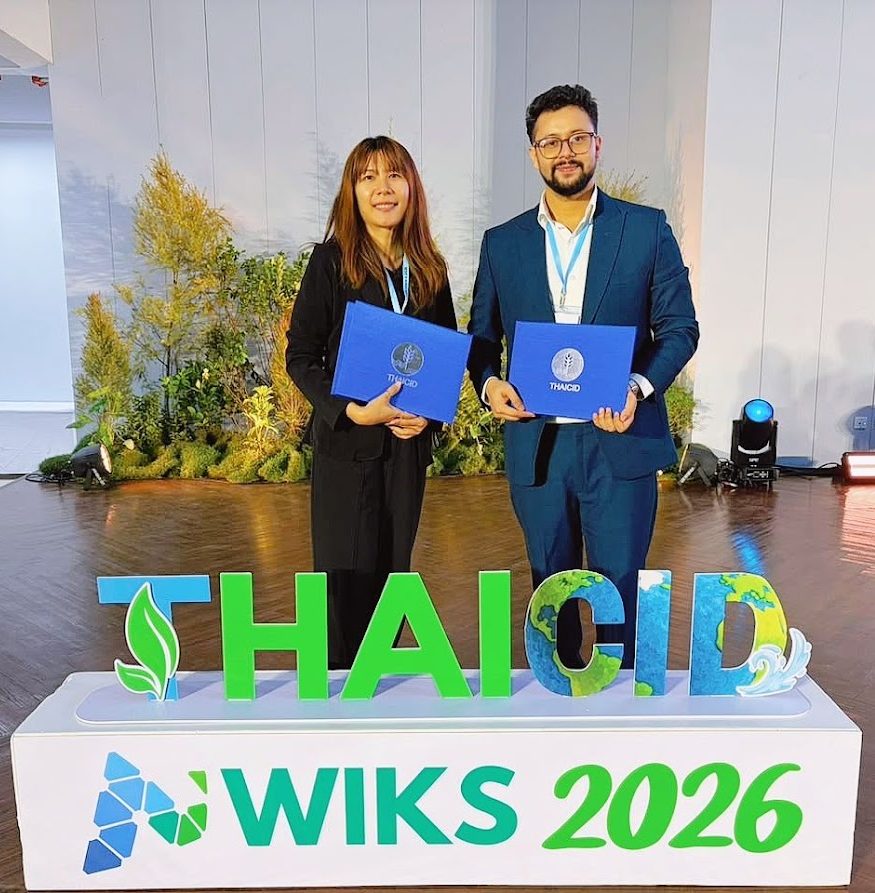
The THAICID (Thai National Committee on Irrigation and Drainage) National Symposium is a prominent annual conference focused on advancing Thailand’s water management, agriculture, and irrigation strategies. Organized by the Royal Irrigation Department, it brings together experts to address critical issues like climate change resilience and smart water management. The main theme of NWIKS event was “How Can Irrigation and Drainage Innovations Drive Climate-Resilient Water and Agriculture through Smart Management, Technology, and Community Action?” with keynote presentations from Dr. Marco Arcieri, President of the International Commission on Irrigation and Drainage (ICID) and Secretary-General of the Italian Commission on Irrigation and Drainage (ITAL-ICID), and Prof. Tsugihiro Watanabe, Honorary Vice President of ICID.
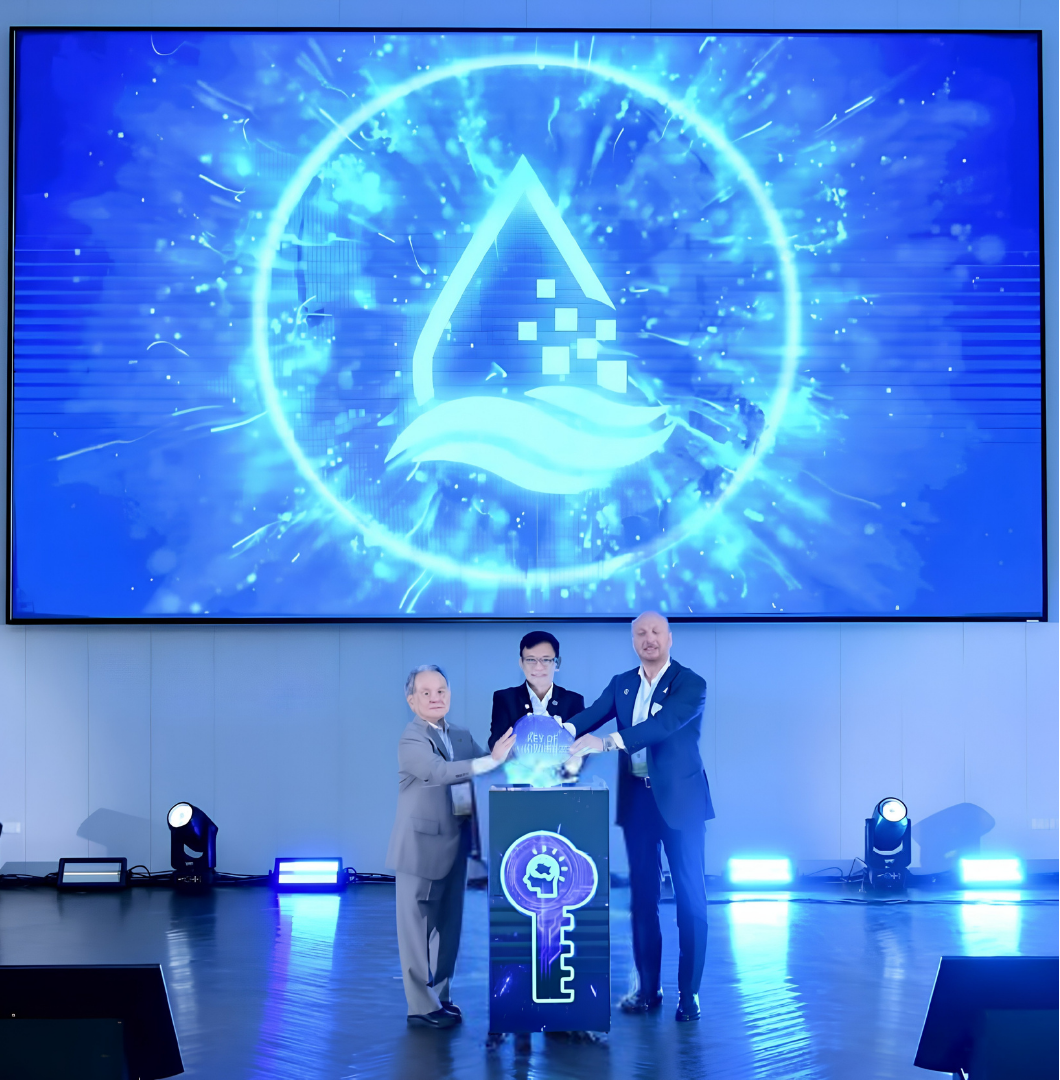
Opening ceremony of the Network Week for Integrated Knowledge Sharing (NWIKS) at the 19th THAICID National Academic Conference (การประชุมวิชาการ THAICID ครั้งที่ 19)
Mr. Bikram Pandey presented the presentation entitled “Enhancing Streamflow Forecasting in Northern Thailand Using the Rainfall–Runoff–Inundation Model and Data Assimilation” on behalf of the research team with Dr. Natthachet Tangdamrongsub, Dr. Piyatida Ruangrassamee, and Mr. Marvin Jade Genoguin.
This study improves streamflow forecasting for the Upper Nan River Basin in Northern Thailand by coupling the Rainfall-Runoff-Inundation (RRI) model with Particle-Filter data assimilation (PF-DA), using GFS forecasted rainfall to drive the model and observed hydraulic data to correct its states. Comparing forecast performance (NSE, KGE, RMSE, bias) before and after data assimilation across 10-day lead times for 2022 and 2024 flood events shows the DA-enhanced model substantially reduces forecast errors. The result is a more robust and reliable forecasting framework suited for flood preparedness and decision support systems.
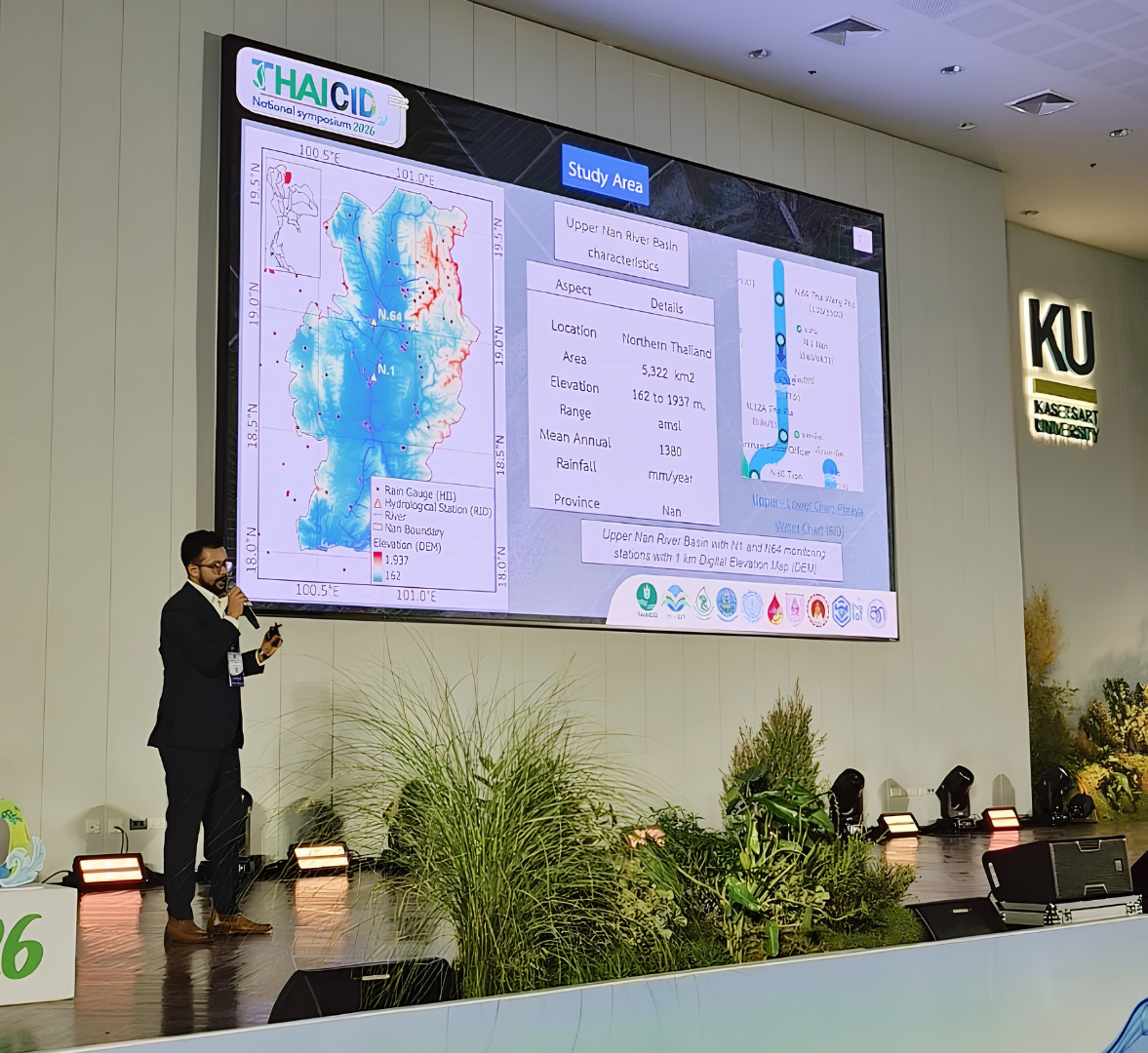
Mr. Bikram Pandey’s presentation “Enhancing Streamflow Forecasting in Northern Thailand Using the Rainfall–Runoff–Inundation Model and Data Assimilation”
Ms. Udomporn Tupbucha presented the presentation on “Reconstructing High-Resolution Inland Water Elevation in Thailand Through Machine Learning Integration of SWOT and ICESat-2 Observations” on behalf of Dr. Natthachet Tangdamrongsub. In summary, they developed an AI-powered bias correction framework that transforms raw SWOT and ICESat-2 observations into highly accurate water surface elevation products. The framework achieved more than 95 percent error reduction and demonstrates strong potential for nationwide water resource monitoring in Thailand.
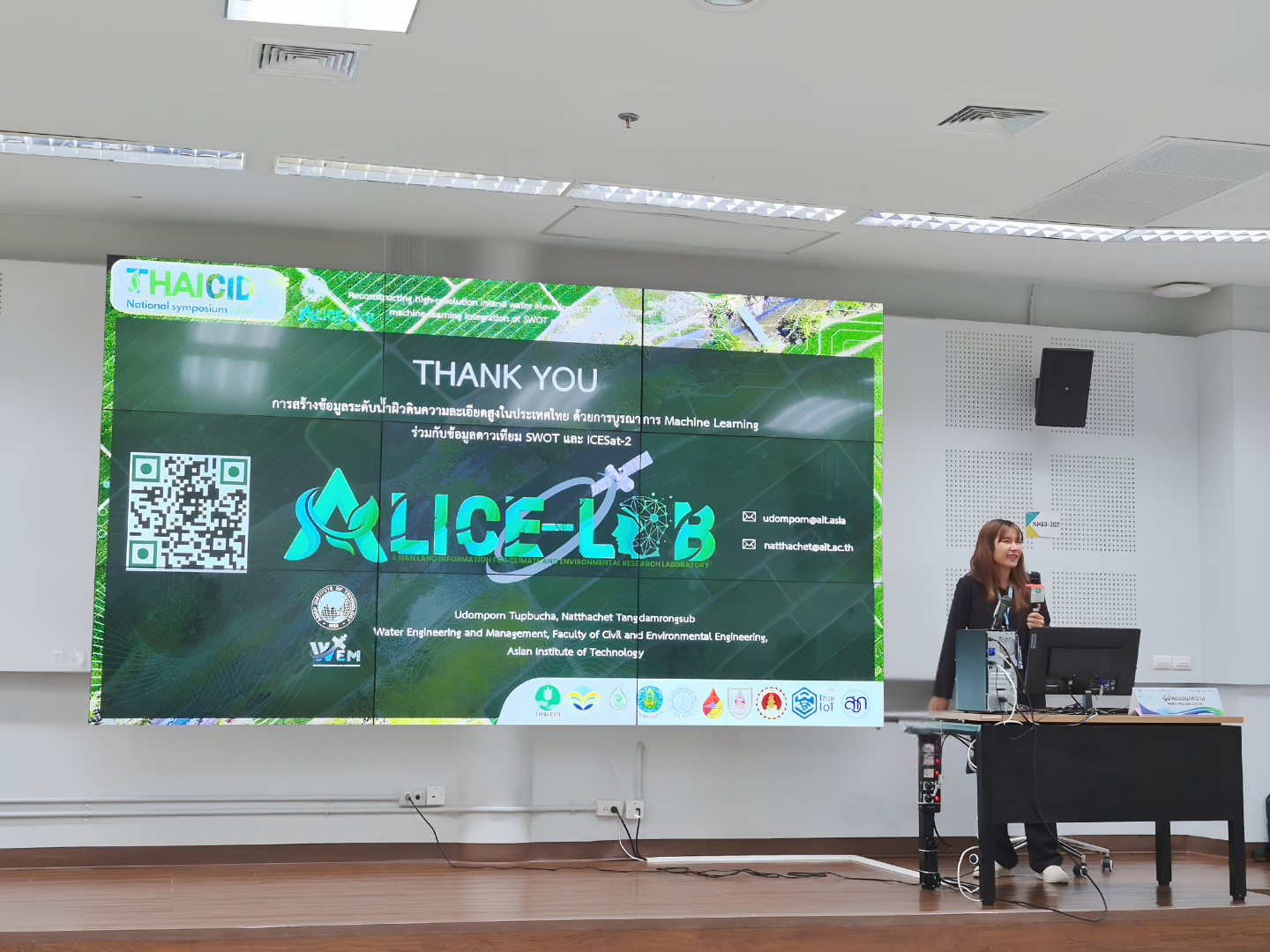
Ms. Udomporn Tupbucha’s presentation “Reconstructing High-Resolution Inland Water Elevation in Thailand Through Machine Learning Integration of SWOT and ICESat-2 Observations”
The Water Engineering and Management program congratulates our researchers on their outstanding work and valuable contributions to advancing climate-resilient water management, digital water technologies, and innovative hydrological research.